
Tender analysis.
Checked, levelled, ranked.
How to check returned tenders for arithmetic, qualifications and omissions, compare them like with like and write the tender report, with a test project.
How do you analyse returned tenders?
Check every tender against the documents you issued before you compare totals: the arithmetic of each priced item, qualifications and exclusions, missing items, provisional sums and the period the tender stays open. Then bring the tenders to a common basis, adding a priced allowance for anything left out, rank them and write the tender report for the client with a recommendation and the points to clarify before the contract is let.
A casting error, a sum left out, VAT in the price
Three things catch reports out. Add up the amounts each return prints, in PDFs too: if they do not reach the tender sum, say so and follow the procedure your invitation states, usually Alternative 1 or 2. Add an excluded provisional sum at the amount your schedule fixes, or the tender looks cheaper by that sum. And compare a tender priced including VAT without VAT, then add VAT once; a homeowner compares what they will actually pay.
What usually changes the ranking
The lowest tender sum is not always the lowest tender. In practice these points move the order:
- Arithmetic errors: quantity times rate does not give the amount carried.
- Items left out or excluded, such as a wall, a beam or the external works.
- Provisional sums changed by the tenderer instead of carried as issued.
- Qualifications such as excluded asbestos or a shorter validity period.
- Errors dealt with differently from the rules stated in the invitation to tender.
What goes in the tender report
The tenders as submitted and as adjusted for comparison, how each adjustment was made, the ranking, the qualifications and the clarifications needed, and a recommendation the client can act on. The client decides; the report gives them a clear basis.
How to do it.
- 01
Check against the issue
Schedule, drawings and the terms of the invitation as the common basis.
- 02
Check the arithmetic
Every priced item, the subtotals and the tender sum.
- 03
Read the qualifications
Exclusions, changed provisional sums, validity and programme.
- 04
Level the tenders
Price the omissions and bring every tender to the same scope.
- 05
Report
Comparison spreadsheet and tender report with a recommendation.
A test project: three tenders for a rear extension.
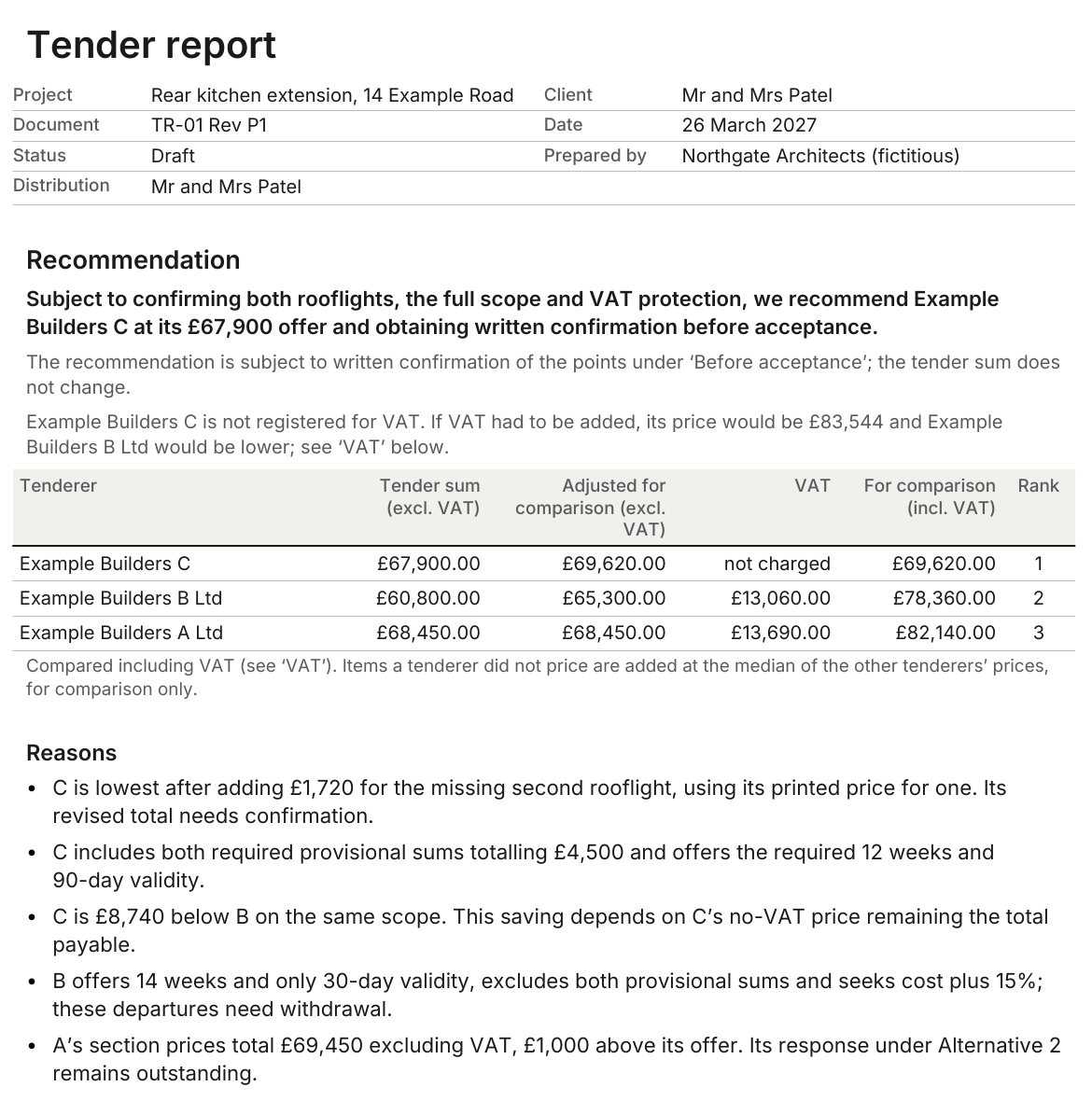
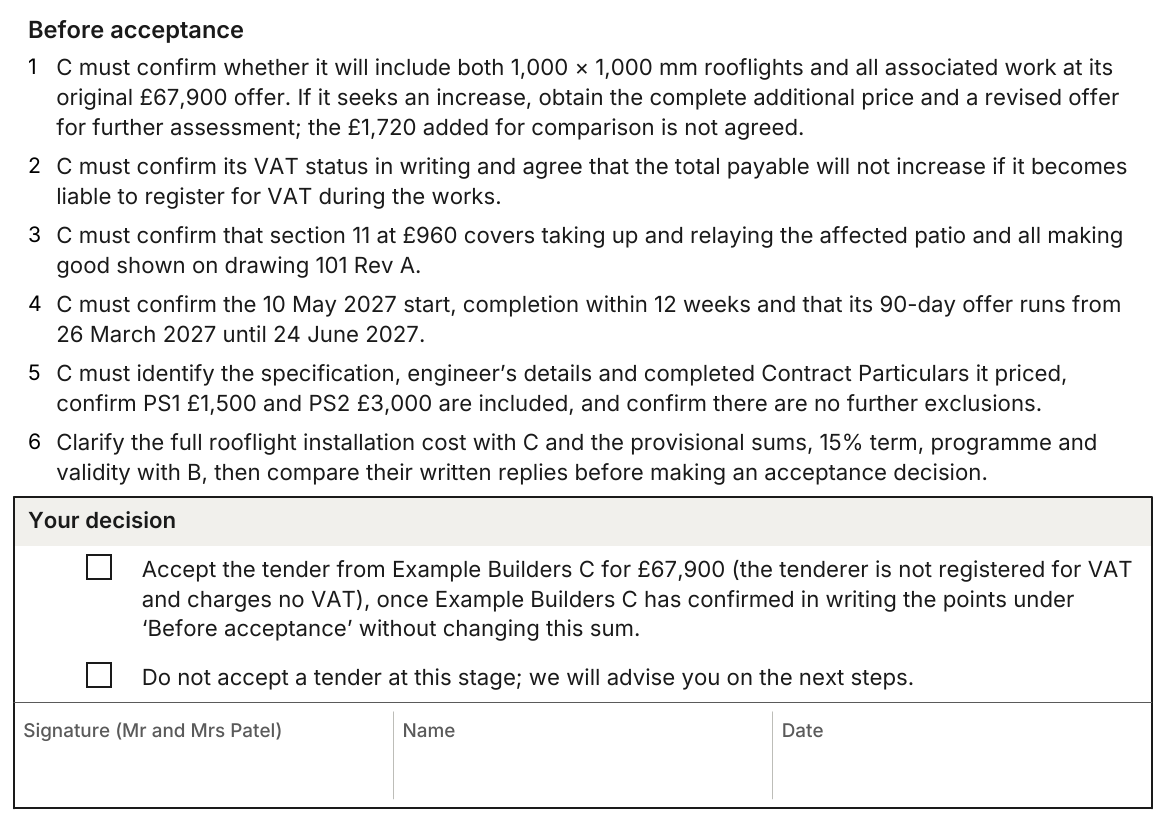
Three returned tenders, the issued schedule of works and the drawing in the project folder: ArchX checked them against the tender rules and wrote the comparison spreadsheet, a six-page tender report with a recommendation and a clarification letter to each tenderer. The lowest tender on paper was not the lowest once its provisional sums and VAT were in.
ArchX working time, measured
is what the lowest tender on paper, £60,800 excluding VAT, costs the clients once the £4,500 of provisional sums it left out and the VAT are in
casting error in a PDF tender: the sections add up to £69,450, the tender sum says £68,450, with the Alternative 2 step the invitation states
Test project: England, with planted errors. A fictitious rear extension, “Northgate Architects (fictitious)” and three tenderers named Example Builders. One run with ChatGPT Pro (GPT 6.1 Sol, very high) and the code of ArchX 0.1.4. See the whole result
Asked briefly.
Does ArchX read tenders as PDF?
Yes. In the test project all three tenders came back as PDF, next to the issued schedule of works as a spreadsheet.
What does ArchX do with an arithmetic error?
It flags the error and applies the rule stated in your invitation to tender. In the test project that is Alternative 2: a draft letter goes to the tenderer, and the report says the reply is outstanding.
Who decides?
The client, on your advice. ArchX drafts the report and the recommendation as Word and PDF; the practice checks and signs them.
How long does it take?
In the test project 9 min 26 s of ArchX working time, measured.
Try it on your own work.
Download ArchX for Mac or Windows and give it a task from your practice. 7 days free with your ChatGPT account (Plus or higher).